

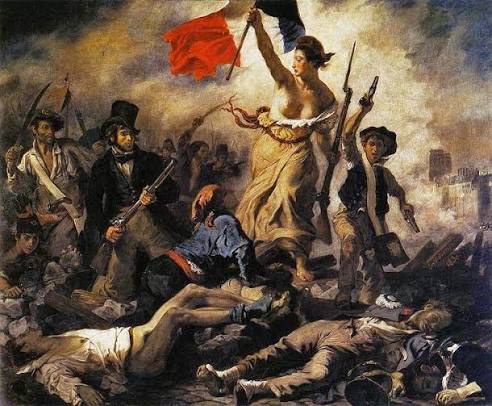
The Declaration of the Rights of Man and of the Citizen, 1789
The representatives of the French People, formed into a National Assembly, considering ignorance, forgetfulness or contempt of the rights of man to be the only causes of public misfortunes and the corruption of Governments, have resolved to set forth, in a solemn Declaration, the natural, unalienable and sacred rights of man, to the end that this Declaration, constantly present to all members of the body politic, may remind them unceasingly of their rights and their duties; to the end that the acts of the legislative power and those of the executive power, since they may be continually compared with the aim of every political institution, may thereby be the more respected; to the end that the demands of the citizens, founded henceforth on simple and incontestable principles, may always be directed toward the maintenance of the Constitution and the happiness of all.
In consequence whereof, the National Assembly recognises and declares, in the presence and under the auspices of the Supreme Being, the following Rights of Man and of the Citizen.
Article first
Men are born and remain free and equal in rights. Social distinctions may be based only on considerations of the common good.
Article 2
The aim of every political association is the preservation of the natural and imprescriptible rights of Man. These rights are Liberty, Property, Safety and Resistance to Oppression.
Article 3
The principle of any Sovereignty lies primarily in the Nation. No corporate body, no individual may exercise any authority that does not expressly emanate from it.
Article 4
Liberty consists in being able to do anything that does not harm others: thus, the exercise of the natural rights of every man has no bounds other than those that ensure to the other members of society the enjoyment of these same rights. These bounds may be determined only by Law.
Article 5
The Law has the right to forbid only those actions that are injurious to society. Nothing that is not forbidden by Law may be hindered, and no one may be compelled to do what the Law does not ordain.
Article 6
The Law is the expression of the general will. All citizens have the right to take part, personally or through their representatives, in its making. It must be the same for all, whether it protects or punishes. All citizens, being equal in its eyes, shall be equally eligible to all high offices, public positions and employments, according to their ability, and without other distinction than that of their virtues and talents.
Article 7
No man may be accused, arrested or detained except in the cases determined by the Law, and following the procedure that it has prescribed. Those who solicit, expedite, carry out, or cause to be carried out arbitrary orders must be punished; but any citizen summoned or apprehended by virtue of the Law, must give instant obedience; resistance makes him guilty.
Article 8
The Law must prescribe only the punishments that are strictly and evidently necessary; and no one may be punished except by virtue of a Law drawn up and promulgated before the offense is committed, and legally applied.
Article 9
As every man is presumed innocent until he has been declared guilty, if it should be considered necessary to arrest him, any undue harshness that is not required to secure his person must be severely curbed by Law.
Article 10
No one may be disturbed on account of his opinions, even religious ones, as long as the manifestation of such opinions does not interfere with the established Law and Order.
Article 11
The free communication of ideas and of opinions is one of the most precious rights of man. Any citizen may therefore speak, write and publish freely, except what is tantamount to the abuse of this liberty in the cases determined by Law.
Article 12
To guarantee the Rights of Man and of the Citizen a public force is necessary; this force is therefore established for the benefit of all, and not for the particular use of those to whom it is entrusted.
Article 13
For the maintenance of the public force, and for administrative expenses, a general tax is indispensable; it must be equally distributed among all citizens, in proportion to their ability to pay.
Article 14
All citizens have the right to ascertain, by themselves, or through their representatives, the need for a public tax, to consent to it freely, to watch over its use, and to determine its proportion, basis, collection and duration.
Article 15
Society has the right to ask a public official for an accounting of his administration.
Article 16
Any society in which no provision is made for guaranteeing rights or for the separation of powers, has no Constitution.
Article 17
Since the right to Property is inviolable and sacred, no one may be deprived thereof, unless public necessity, legally ascertained, obviously requires it, and just and prior indemnity has been paid.
The INDUSTRIAL WORKERS OF THE WORLD CONSTITUTION, PREAMBLE, 1905
The working class and the employing class have nothing in common. There can be no peace so long as hunger and want are found among millions of the working people and the few, who make up the employing class, have all the good things of life.
Between these two classes a struggle must go on until the workers of the world organize as a class, take possession of the means of production, abolish the wage system, and live in harmony with the Earth.
We find that the centering of the management of industries into fewer and fewer hands makes the trade unions unable to cope with the ever growing power of the employing class. The trade unions foster a state of affairs which allows one set of workers to be pitted against another set of workers in the same industry, thereby helping defeat one another in wage wars. Moreover, the trade unions aid the employing class to mislead the workers into the belief that the working class have interests in common with their employers.
These conditions can be changed and the interest of the working class upheld only by an organization formed in such a way that all its members in any one industry, or in all industries if necessary, cease work whenever a strike or lockout is on in any department thereof, thus making an injury to one an injury to all.
Instead of the conservative motto, “A fair day’s wage for a fair day’s work,” we must inscribe on our banner the revolutionary watchword, “Abolition of the wage system.”
It is the historic mission of the working class to do away with capitalism. The army of production must be organized, not only for everyday struggle with capitalists, but also to carry on production when capitalism shall have been overthrown. By organizing industrially we are forming the structure of the new society within the shell of the old.
WWII DECLARATION OF WAR, December 1941
JOINT RESOLUTION Declaring that a state of war exists between the Imperial Government of Japan and the Government and the people of the United States and making provisions to prosecute the same.
Whereas the Imperial Government of Japan has committed unprovoked acts of war against the Government and the people of the United States of America:
Therefore be it Resolved by the Senate and House of Representatives of the United States of America in Congress assembled, That the state of war between the United States and the Imperial Government of Japan which has thus been thrust upon the United States is hereby formally declared; and the President is hereby authorized and directed to employ the entire naval and military forces of the United States and the resources of the Government to carry on war against the Imperial Government of Japan; and, to bring the conflict to a successful termination, all the resources of the country are hereby pledged by the Congress of the United States.
Vietnam Declaration of Independence, Sept 1945
All men are created equal. They are endowed by their Creator with certain inalienable rights, among them are Life, Liberty, and the pursuit of Happiness.”
This immortal statement was made in the Declaration of Independence of the United States of America in 1776. In a broader sense, this means: All the peoples on the earth are equal from birth, all the peoples have a right to live, to be happy and free.
The Declaration of the French Revolution made in 1791 on the Rights of Man and the Citizen also states: “All men are born free and with equal rights, and must always remain free and have equal rights.”
Those are undeniable truths.
Nevertheless, for more than eighty years, the French imperialists, abusing the standard of Liberty, Equality, and Fraternity, have violated our Fatherland and oppressed our fellow-citizens. They have acted contrary to the ideals of humanity and justice.
In the field of politics, they have deprived our people of every democratic liberty.
They have enforced inhuman laws; they have set up three distinct political regimes in the North, the Center and the South of Vietnam in order to wreck our national unity and prevent our people from being united.
They have built more prisons than schools. They have mercilessly slain our patriots; they have drowned our uprisings in rivers of blood.
They have fettered public opinion; they have practiced obscurantism against our people.
To weaken our race they have forced us to use opium and alcohol.
In the field of economics, they have fleeced us to the backbone, impoverished our people, and devastated our land.
They have robbed us of our rice fields, our mines, our forests, and our raw materials. They have monopolized the issuing of bank-notes and the export trade.
They have invented numerous unjustifiable taxes and reduced our people, especially our peasantry, to a state of extreme poverty.
They have hampered the prospering of our national bourgeoisie; they have mercilessly exploited our workers.
In the autumn of 1940, when the Japanese Fascists violated Indochina’s territory to establish new bases in their fight against the Allies, the French imperialists went down on their bended knees and handed over our country to them.
Thus, from that date, our people were subjected to the double yoke of the French and the Japanese. Their sufferings and miseries increased. The result was that from the end of last year to the beginning of this year, from Quang Tri province to the North of Vietnam, more than two million of our fellow-citizens died from starvation. On March 9, the French troops were disarmed by the Japanese. The French colonialists either fled or surrendered showing that not only were they incapable of “protecting” us, but that, in the span of five years, they had twice sold our country to the Japanese.
On several occasions before March 9, the Vietminh League urged the French to ally themselves with it against the Japanese. Instead of agreeing to this proposal, the French colonialists so intensified their terrorist activities against the Vietminh members that before fleeing they massacred a great number of our political prisoners detained at Yen Bay and Caobang.
Notwithstanding all this, our fellow-citizens have always manifested toward the French a tolerant and humane attitude. Even after the Japanese putsch of March 1945, the Vietminh League helped many Frenchmen to cross the frontier, rescued some of them from Japanese jails, and protected French lives and property.
From the autumn of 1940, our country had in fact ceased to be a French colony and had become a Japanese possession.
After the Japanese had surrendered to the Allies, our whole people rose to regain our national sovereignty and to found the Democratic Republic of Vietnam.
The truth is that we have wrested our independence from the Japanese and not from the French.
The French have fled, the Japanese have capitulated, Emperor Bao Dai has abdicated. Our people have broken the chains which for nearly a century have fettered them and have won independence for the Fatherland. Our people at the same time have overthrown the monarchic regime that has reigned supreme for dozens of centuries. In its place has been established the present Democratic Republic.
For these reasons, we, members of the Provisional Government, representing the whole Vietnamese people, declare that from now on we break off all relations of a colonial character with France; we repeal all the international obligation that France has so far subscribed to on behalf of Vietnam and we abolish all the special rights the French have unlawfully acquired in our Fatherland.
The whole Vietnamese people, animated by a common purpose, are determined to fight to the bitter end against any attempt by the French colonialists to reconquer their country.
We are convinced that the Allied nations which at Tehran and San Francisco have acknowledged the principles of self-determination and equality of nations, will not refuse to acknowledge the independence of Vietnam.
A people who have courageously opposed French domination for more than eight years, a people who have fought side by side with the Allies against the Fascists during these last years, such a people must be free and independent.
For these reasons, we, members of the Provisional Government of the Democratic Republic of Vietnam, solemnly declare to the world that Vietnam has the right to be a free and independent country—and in fact is so already. The entire Vietnamese people are determined to mobilize all their physical and mental strength, to sacrifice their lives and property in order to safeguard their independence and liberty.
Source: Ho Chi Minh, Selected Works Vol. 3, (Hanoi: Foreign Languages Publishing House, 1960–62), 17–21.
Universal Declaration of Human Rights, 1948
Preamble
Whereas recognition of the inherent dignity and of the equal and inalienable rights of all members of the human family is the foundation of freedom, justice and peace in the world,
Whereas disregard and contempt for human rights have resulted in barbarous acts which have outraged the conscience of mankind, and the advent of a world in which human beings shall enjoy freedom of speech and belief and freedom from fear and want has been proclaimed as the highest aspiration of the common people,
Whereas it is essential, if man is not to be compelled to have recourse, as a last resort, to rebellion against tyranny and oppression, that human rights should be protected by the rule of law,
Whereas it is essential to promote the development of friendly relations between nations,
Whereas the peoples of the United Nations have in the Charter reaffirmed their faith in fundamental human rights, in the dignity and worth of the human person and in the equal rights of men and women and have determined to promote social progress and better standards of life in larger freedom,
Whereas Member States have pledged themselves to achieve, in cooperation with the United Nations, the promotion of universal respect for and observance of human rights and fundamental freedoms,
Whereas a common understanding of these rights and freedoms is of the greatest importance for the full realization of this pledge,
Now, therefore, The General Assembly,
Proclaims this Universal Declaration of Human Rights as a common standard of achievement for all peoples and all nations, to the end that every individual and every organ of society, keeping this Declaration constantly in mind, shall strive by teaching and education to promote respect for these rights and freedoms and by progressive measures, national and international, to secure their universal and effective recognition and observance, both among the peoples of Member States themselves and among the peoples of territories under their jurisdiction.
Article 1: All human beings are born free and equal in dignity and rights. They are endowed with reason and conscience and should act towards one another in a spirit of brotherhood.
Article 2: Everyone is entitled to all the rights and freedoms set forth in this Declaration, without distinction of any kind, such as race, colour, sex, language, religion, political or other opinion, national or social origin, property, birth or other status.
Furthermore, no distinction shall be made on the basis of the political, jurisdictional or international status of the country or territory to which a person belongs, whether it be independent, trust, non-self-governing or under any other limitation of sovereignty.
Article 3: Everyone has the right to life, liberty and the security of person.
Article 4: No one shall be held in slavery or servitude; slavery and the slave trade shall be prohibited in all their forms.
Article 5: No one shall be subjected to torture or to cruel, inhuman or degrading treatment or punishment.
Article 6: Everyone has the right to recognition everywhere as a person before the law.
Article 7: All are equal before the law and are entitled without any discrimination to equal protection of the law. All are entitled to equal protection against any discrimination in violation of this Declaration and against any incitement to such discrimination.
Article 8: Everyone has the right to an effective remedy by the competent national tribunals for acts violating the fundamental rights granted him by the constitution or by law.
Article 9: No one shall be subjected to arbitrary arrest, detention or exile.
Article 10: Everyone is entitled in full equality to a fair and public hearing by an independent and impartial tribunal, in the determination of his rights and obligations and of any criminal charge against him.
Article 11
- Everyone charged with a penal offence has the right to be presumed innocent until proved guilty according to law in a public trial at which he has had all the guarantees necessary for his defence.
- No one shall be held guilty of any penal offence on account of any act or omission which did not constitute a penal offence, under national or international law, at the time when it was committed. Nor shall a heavier penalty be imposed than the one that was applicable at the time the penal offence was committed.
Article 12: No one shall be subjected to arbitrary interference with his privacy, family, home or correspondence, nor to attacks upon his honour and reputation. Everyone has the right to the protection of the law against such interference or attacks.
Article 13
- Everyone has the right to freedom of movement and residence within the borders of each State.
- Everyone has the right to leave any country, including his own, and to return to his country.
Article 14
- Everyone has the right to seek and to enjoy in other countries asylum from persecution.
- This right may not be invoked in the case of prosecutions genuinely arising from non-political crimes or from acts contrary to the purposes and principles of the United Nations.
Article 15
- Everyone has the right to a nationality.
- No one shall be arbitrarily deprived of his nationality nor denied the right to change his nationality.
Article 16
- Men and women of full age, without any limitation due to race, nationality or religion, have the right to marry and to found a family. They are entitled to equal rights as to marriage, during marriage and at its dissolution.
- Marriage shall be entered into only with the free and full consent of the intending spouses.
- The family is the natural and fundamental group unit of society and is entitled to protection by society and the State.
Article 17
- Everyone has the right to own property alone as well as in association with others.
- No one shall be arbitrarily deprived of his property.
Article 18: Everyone has the right to freedom of thought, conscience and religion; this right includes freedom to change his religion or belief, and freedom, either alone or in community with others and in public or private, to manifest his religion or belief in teaching, practice, worship and observance.
Article 19: Everyone has the right to freedom of opinion and expression; this right includes freedom to hold opinions without interference and to seek, receive and impart information and ideas through any media and regardless of frontiers.
Article 20
- Everyone has the right to freedom of peaceful assembly and association.
- No one may be compelled to belong to an association.
Article 21
- Everyone has the right to take part in the government of his country, directly or through freely chosen representatives.
- Everyone has the right of equal access to public service in his country.
- The will of the people shall be the basis of the authority of government; this will shall be expressed in periodic and genuine elections which shall be by universal and equal suffrage and shall be held by secret vote or by equivalent free voting procedures.
Article 22: Everyone, as a member of society, has the right to social security and is entitled to realization, through national effort and international co-operation and in accordance with the organization and resources of each State, of the economic, social and cultural rights indispensable for his dignity and the free development of his personality.
Article 23
- Everyone has the right to work, to free choice of employment, to just and favourable conditions of work and to protection against unemployment.
- Everyone, without any discrimination, has the right to equal pay for equal work.
- Everyone who works has the right to just and favourable remuneration ensuring for himself and his family an existence worthy of human dignity, and supplemented, if necessary, by other means of social protection.
- Everyone has the right to form and to join trade unions for the protection of his interests.
Article 24: Everyone has the right to rest and leisure, including reasonable limitation of working hours and periodic holidays with pay.
Article 25
- Everyone has the right to a standard of living adequate for the health and well-being of himself and of his family, including food, clothing, housing and medical care and necessary social services, and the right to security in the event of unemployment, sickness, disability, widowhood, old age or other lack of livelihood in circumstances beyond his control.
- Motherhood and childhood are entitled to special care and assistance. All children, whether born in or out of wedlock, shall enjoy the same social protection.
Article 26
- Everyone has the right to education. Education shall be free, at least in the elementary and fundamental stages. Elementary education shall be compulsory. Technical and professional education shall be made generally available and higher education shall be equally accessible to all on the basis of merit.
- Education shall be directed to the full development of the human personality and to the strengthening of respect for human rights and fundamental freedoms. It shall promote understanding, tolerance and friendship among all nations, racial or religious groups, and shall further the activities of the United Nations for the maintenance of peace.
- Parents have a prior right to choose the kind of education that shall be given to their children.
Article 27
- Everyone has the right freely to participate in the cultural life of the community, to enjoy the arts and to share in scientific advancement and its benefits.
- Everyone has the right to the protection of the moral and material interests resulting from any scientific, literary or artistic production of which he is the author.
Article 28: Everyone is entitled to a social and international order in which the rights and freedoms set forth in this Declaration can be fully realized.
Article 29
- Everyone has duties to the community in which alone the free and full development of his personality is possible.
- In the exercise of his rights and freedoms, everyone shall be subject only to such limitations as are determined by law solely for the purpose of securing due recognition and respect for the rights and freedoms of others and of meeting the just requirements of morality, public order and the general welfare in a democratic society.
- These rights and freedoms may in no case be exercised contrary to the purposes and principles of the United Nations.
Article 30: Nothing in this Declaration may be interpreted as implying for any State, group or person any right to engage in any activity or to perform any act aimed at the destruction of any of the rights and freedoms set forth herein.

