

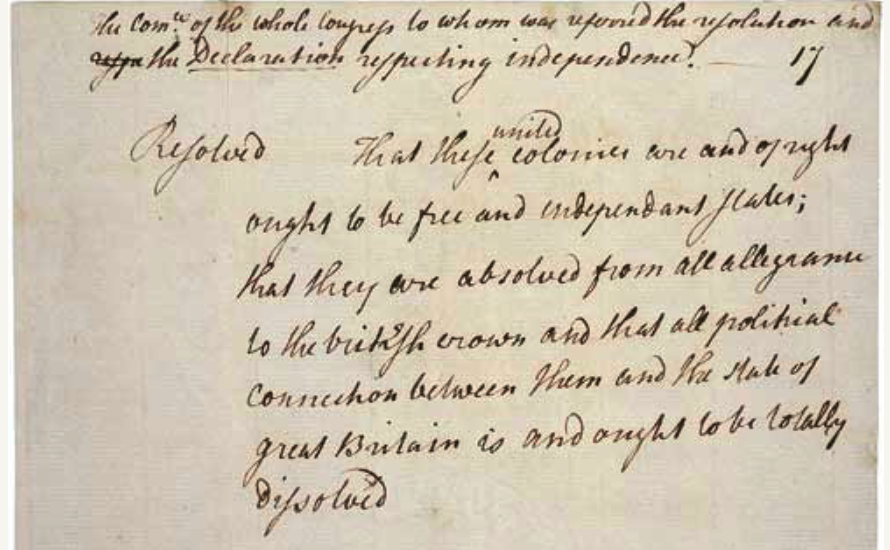
NATICK, MASSACHUSETTS. June 20, 1776. Force, ed., American Archives, VI: 703
At a meeting of the town of Natick, June 20, 1776, legally warned, in consequence of a resolve of the late House of Representatives being laid before the Town, setting forth their sense of the obligations that lie upon every town in this Colony solemnly to engage to support with their lives and fortunes the honourable Continental Congress, should said Congress, for the safety of the Colonies, come into the measure of declaring themselves independent of the Kingdom of Great Britain, it was unanimously
Voted, That, in consideration of the many acts of the British Parliament, passed at divers sessions of the same, within about thirteen years past, relating to said Colonies, especially those within the two or three last years, by which every idea of moderation, justice, humanity, and Christianity are entirely laid aside, and those principles and measures adopted and pursued which would disgrace the most unenlightened and uncivilized tribe of aboriginal natives in the most interior parts of this extensive continent; and, also, in consequence of the glaring impropriety, incapacity, and fatal tendency, of any State whatever, at the distance of three thousand miles, to legislate for these Colonies, which at the same time are so numerous, so knowing, and capable of legislating; or to have a negative upon those laws which they, in their respective Assemblies, and by their united representation in General Congress, shall, from time to time, want and establish for themselves; and upon divers other considerations, which, for brevity’s sake, we omit to mention,—we, the inhabitants of Natick, in town-meeting assembled, do hereby declare, agreeable to the tenor of the aforementioned resolve, that, should the honourable Continental Congress declare these American Colonies independent of the Kingdom of Great Britain, we will, with our lives and fortunes, join with the other inhabitants of this Colony, and with those of the other Colonies, in supporting them in such measure, which we look upon to be both important and necessary, and which, if we may be permitted to suggest our opinion, the sooner it is come into the fewer difficulties we shall have to contend with, and the grand objects of peace, liberty, and safety, will be more likely speedily to be restored and established in our once happy land.
Maier, Pauline. American Scripture: Making the Declaration of Independence . Knopf Doubleday
George Mason’s draft of the Virginia Declaration of Rights, June 12, 1776
A DECLARATION OF RIGHTS made by the Representatives of the good people of VIRGINIA, assembled in full and free Convention; which rights do pertain to them and their posterity, as the basis and foundation of Government.
1. That all men are by nature equally free and independent, and have certain inherent rights, of which, when they enter into a state of society, they cannot, by any compact, deprive or divest their posterity; namely, the enjoyment of life and liberty, with the means of acquiring and possessing property, and pursuing and obtaining happiness and safety.
2. That all power is vested in, and consequently derived from, the People; that magistrates are their trustees and servants, and at all times amenable to them.
3. That Government is, or ought to be, instituted for the common benefit, protection, and security of the people, nation, or community;—of all the various modes and forms of Government that is best which is capable of producing the greatest degree of happiness and safety, and is most effectually secured against the danger of mal‑administration;—and that, whenever any Government shall be found inadequate or contrary to these purposes, a majority of the community hath an indubitable, unalienable, and indefeasible right, to reform, alter, or abolish it, in such manner as shall be judged most conducive to the publick weal…
Jefferon’s draft of the Preamble of the Voirginia Constitution, June 29, 1776
Thomas Jefferson wrote the preamble to the Virginia Constitution. Adopted on June 29, 1776, Jefferson’s third draft of the Virginia Constitution began:
A Bill for new‑modelling the form of Government and for establishing the Fundamental principles thereof in future.
Whereas George Guelf king of Great Britain and Ireland and Elector of Hanover, heretofore entrusted with the exercise of the kingly office in this government hath endeavored to pervert the same into a detestable and insupportable tyranny;
by putting his negative on laws the most wholesome & necessary for ye. public good;
by denying to his governors permission to pass laws of immediate & pressing importance, unless suspended in their operation for his assent, and, when so suspended, neglecting to attend to them for many years;
by refusing to pass certain other laws, unless the persons to be benefited by them would relinquish the inestimable right of representation in the legislature;
by dissolving legislative assemblies repeatedly and continually for opposing with manly firmness his invasions on the rights of the people;
when dissolved, by refusing to call others for a long space of time, thereby leaving the political system without any legislative head;
by endeavoring to prevent the population of our country, & for that purpose obstructing the laws for the naturalization of foreigners & raising the conditions of new appropriations of lands;
by keeping among us, in times of peace, standing armies & ships of war;
by affecting to render the military independent of & superior to the civil power;
by combining with others to subject us to a foreign jurisdiction, giving his assent to their pretended acts of legislation
for quartering large bodies of troops among us;
for cutting off our trade with all parts of the world;
for imposing taxes on us without our consent;
for depriving us of the benefits of trial by jury;
for transporting us beyond seas to be tried for pretended offences; and
for suspending our own legislatures & declaring themselves invested with power to legislate for us in all cases whatsoever;
by plundering our seas, ravaging our coasts, burning our towns and destroying the lives of our people;
by inciting insurrections of our fellow subjects with the allurements of forfeiture & confiscation
by prompting our negroes to rise in arms among us; those very negroes whom by an inhuman use of his negative he hath refused us permission to exclude by law
by endeavoring to bring on the inhabitants of our frontiers the merciless Indian savages, whose known rule of warfare is an undistinguished destruction of all ages, sexes, & conditions of existence;
by transporting at this time a large army of foreign mercenaries to compleat the works of death, desolation, & tyranny already begun with circumstances of cruelty & perfidy so unworthy the head of a civilized nation;
by answering our repeated petitions for redress with a repetition of injuries;
and finally by abandoning the helm of government and declaring us out of his allegiance & protection;
by which several acts of misrule the said George Guelf has forfeited the kingly office and has rendered it necessary for the preservation of the people that he should be immediately deposed from the same, and divested of all it’s privileges, powers, & prerogatives…
Hirsch, David; Van Haften, Dan. The Ultimate Guide to the Declaration of Independence (pp. 44-48).

